The Unexpected Gift of Tidying with Your Child
Decluttering and Organizing
are often thought of as practical tasks — sorting, discarding, and finding a place for everything. And that is, of course, true.
But when approached with awareness and intention, tidying can become something much deeper – a way of learning how to tune-in to ourselves and reconnect with what truly brings us joy. The kind of joy that helps us feel grateful. The kind of joy that reminds us what truly matters in life.
Yet cluttered homes, cluttered schedules and cluttered minds can obscure those things. When every surface is covered, every hour feels full, and every thought feels urgent, there is very little space to pause, breathe and be truly present with the people we love. To fully listen without mentally running through tomorrow's to-do list. To enjoy playing that exciting new board game without feeling the pull of the phone every time it buzzes. To share a screen-free meal — tasting the food and enjoying each other's company.
But when we decide to tidy our homes from awareness, we start to create that space for ourselves and our family. Space to be fully present. Here and now. Choice by intentional choice, we strengthen our ability to listen to the wisest part of ourselves. The part that truly knows what brings us joy.
And when we begin to feel this shift — in our homes, in our daily lives, in ourselves — of course we want the same for our children.
“The most powerful teaching is not what you say or do to them, but your state of consciousness at home. That’s the very foundation for teaching your children.”
So if we want to help our children not only develop tidying skills but also learn how to tune-in to themselves and trust their own inner knowing, the best place to start is with ourselves — and with our own things.
YOU AND YOUR THINGS
1. Begin with the Breath
A conscious breath interrupts our mental noise — the obsessive, unproductive thoughts — and reconnects us with ourselves and the present moment. So this is where we always begin. The more you practice this, the easier it becomes to access. Take as many breaths as you’d like. And need.
Inhale 2, 3
Exhale 2,3
2. Start with a Clothing Subcategory
The KonMari method tidies by category, and clothing is the first. It is a big one though, so start with a subcategory – the kinds of pieces you reach for most in the current season. For example:
Winter: warm sweaters
Fall: long-sleeve tops
Spring: short sleeve tops
Summer: tank tops or summer dresses
Gather every piece from that single subcategory in one place. On top of the bed usually works nicely. Pick up one item at a time and take a conscious breath with each. Then, ask yourself one simple question:
“Does this make me feel good?”
Not: Should I keep this?
Not: What if I need it in five years?
Not: But it was a gift…
Just: Does it make me feel good?
Each yes piece gets gratefully returned to your closet or drawer. Each no or ‘eh’ piece gets released with appreciation – on its way to a new life as a recycle or donation.
During my own KonMari tidying, I came across a cocktail dress I had worn maybe once and would probably never wear again. By every practical measure it should have gone. But every time I looked at it, I could feel the joy rise up in me. So stay it did. That dress is still in my closet — and will remain there until it no longer brings me joy. No justification needed.
A particular pair of wedge heels with green satin tie-ups were the opposite. I had loved them for years. I hadn't worn them in a while, though, so I tried them on. The moment I did, I knew. They no longer brought me joy. Not because anything was wrong with them, not because they weren’t special, but because something had shifted in me. And that was enough.
Now, in the rare case that you come across a piece that is absolutely necessary but doesn’t make you feel good, you have two choices:
– Replace it with something that serves the same function and brings you joy
– Acknowledge and appreciate what this piece does for you — “Wow, this undergarment really smooths out my curves when I wear it under that dress.” I know I would find joy in that!
Once you finish one clothing subcategory, move onto the next until you have been through all of your clothing. It doesn’t have to be the same day. It doesn't have to be the same week or even the same month, but set a goal for yourself – “In two months I will have gone through all of my clothing.”
I like to list all of the subcategories and check or cross each off the list as I go. It’s really satisfying!
During this process, keep breathing and really listen to yourself – not the words in your head but the feelings in your body, the way your face lights up or doesn’t – the subtle signals that reveal what is truly right for you.
The more you declutter and organize this way, the more you will become attuned to yourself – your presence – and what brings you joy.
Wondering how to bring this same spirit of presence and joy into the rest of your home?
Here is the link to my free guide - Organize with Intention
to help you create a peaceful, clutter-free space your whole family can feel at home in.
YOU, YOUR CHILD AND THEIR THINGS
Now that you have begun mindfully tidying this way, it becomes much easier to help your child do the same – think of it as the oxygen-mask principle applied to home life!
1. Breathe Together
This can be super bonding. It’s the perfect opportunity to put everything else aside and be fully present with your child. And, as Eckhart Tolle says, there is nothing they feel more deeply than your full attention.
Inhale 2, 3
Exhale 2, 3
Sometimes, children are more ready for this than we might think. Recently, my phone dinged while I was with my niece and nephew, ages seven and five. They asked what it was. It was a reminder from the Eckhart Tolle Now app to sit quietly and breathe for one minute. When I explained, they asked me to do it right then and there so they could join in! Eyes open or closed, all we did was breathe together. And right away, they asked to do it again. The next time I saw them, without any prompting from me, they wanted to do it once more — to my surprise and utter delight!
2. Start with this Sentimental Items Subcategory
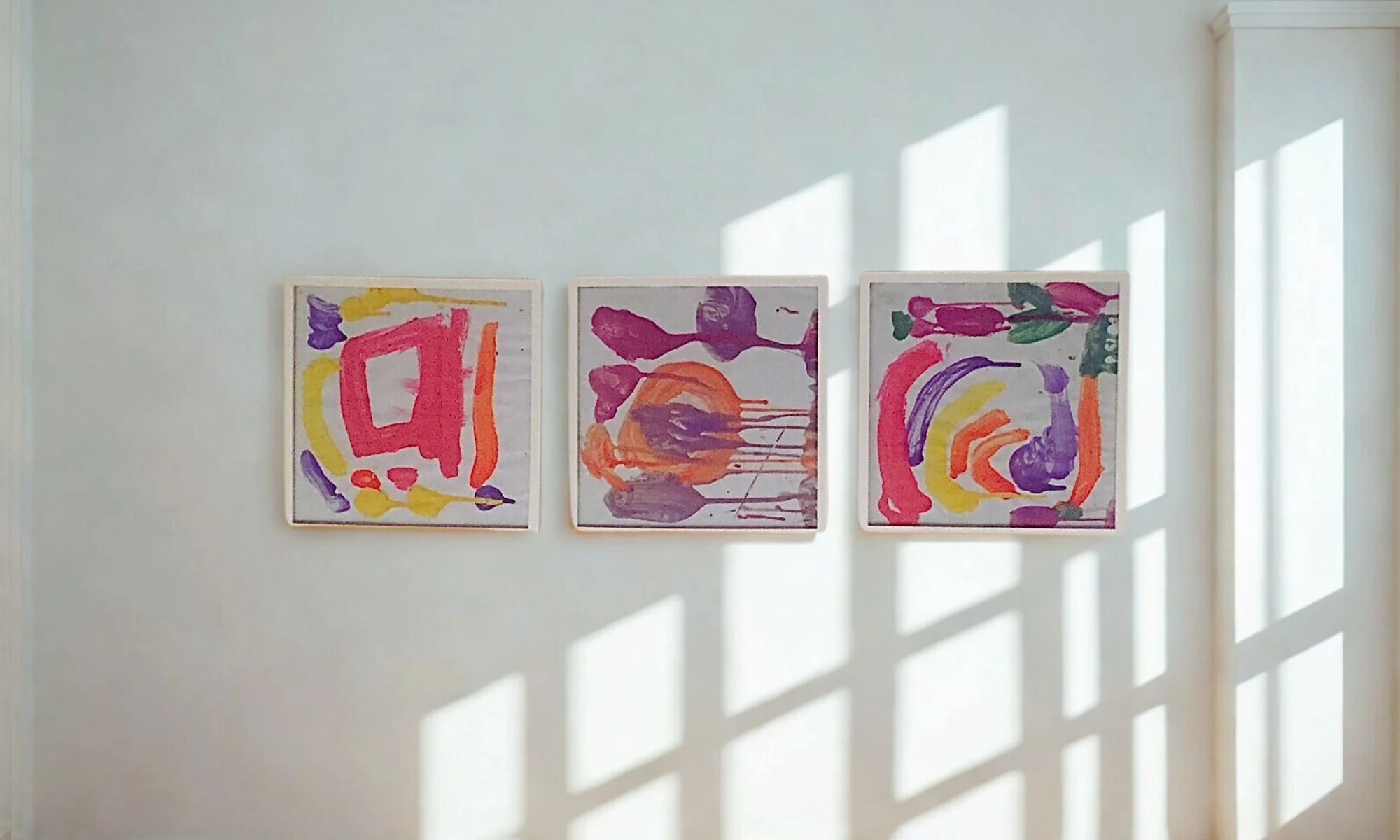
Let’s talk about artwork! The masterpieces, the experiments, and everything in between.
While the sentimental items category is the last in the KonMari tidying method, I know this subcategory can feel overwhelming for a lot of parents, so I chose it here because it is also one of the most rewarding to organize.
If you have an older child, this same system can be applied to things like school papers, awards, memorabilia, and other sentimental items they’ve accumulated over the years.
Gather together all of one child’s artwork, crafts and creative school projects. I know this might be A LOT, but it’s the best way to help them see the full picture and guide them through challenging choices.
3. Guide Your Child to Choose Their Top ‘Joy Pieces’
You might land on 5 or 10 pieces, or it might be more — just keep your space in mind.
Use what you discovered in your own decluttering process to help guide them through choosing the pieces that bring them the most joy. And yes, letting go of papers containing only two marker squiggles or a single enthusiastic sticker is part of the process. :)
I did this with my same nephew and was quite surprised by how decisive he was — knowing almost immediately which things mattered to him and which didn’t. It might not take as much effort as you anticipate!
Just as importantly, show them how to release what doesn’t bring them joy with gratitude. “Thank you coloring book for giving me hours of fun time together.”
I would also suggest involving them in the donation process itself — bringing their things directly to a local shelter or school donation drive. There is something powerful about a child placing their own belongings into someone else's hands. It transforms letting go into giving, and giving into gratitude. Not just for what they are passing on, but for everything they have.
4. Photograph the Rest and Out of the House It Goes
Take photos of everything else and discard these items. Then, create a book (or two) of all the photos. There are many online choices these days – two are Scribble and Plum Print .
A single book per year becomes a lovely tradition and creates a keepsake you and your child will treasure!
5. Display Their Special Pieces with Care
Depending on the configuration of your space:
– Frame a few
– Create a beautiful cork-board layout
– Wallpaper the art inside a closet door for a delightful surprise
When children see their joy pieces honored, they learn to respect their things, and begin to understand that value and meaning are about quality instead of quantity. In that moment, it becomes an invisible lesson in tuning-in to their own sense of joy.
YOU, YOUR CHILD AND THE UNEXPECTED GIFT
Decluttering and organizing your home — with awareness, with honesty, with intention — asks something of you. But what it asks is the most important work you can do: reconnecting with yourself, here and now.
The more you practice tidying this way — pausing, breathing, and truly listening to yourself — the more naturally present you become, in your home and in your life.
And when you do, your children feel it — maybe not consciously, maybe not in a way they could ever articulate, but they feel it and absorb it.
Your presence becomes their model.
Your guidance and instruction show them the way.
Your joy becomes permission for them to follow their own.
To grow up knowing how to listen to themselves, and to trust what they hear.
What better gift could there be.
If this has resonated with you and you'd like to be guided through the process, I'd love to connect with you for a
complimentary consultation.
~ Selena