How to Finally Clean Out Your Junk Drawer
The place where batteries go to die.
Where rubber bands dissolve into a powdery mess.
Where mystery keys seem to multiply.
And where something sticky, that you absolutely did not put in there, is stuck to the bottom of the drawer.
You know what I’m talking about.
The packed-to-the-gills, catch-all, just-throw-it-in-there, feral junk drawer.
Most of us have one. Most of us grew up with one. Most of us always thought that a junk drawer was supposed to be a mess.
Perhaps that’s where you temporarily put the funnily shaped electric plug that you intended to ask your spouse about.
Maybe, on your way out the door, you removed the dry-cleaner’s tag from your coat and just tossed the safety pin in there.
Perhaps, at one point, you decided that the drawer was a good place to keep all of your post-its but now you have so many that they just keep the drawer from closing all the way.
Or maybe you thought there was no good reason to throw away a perfectly reusable white plastic spoon or that random hair band you keep meaning to put in your bathroom.
Maybe there is a Mr. or Ms. Fix-It in your home too…
My mom has told me that when she was growing up, if something wasn't working around the house — a clock, the radio — my grandfather would take the whole thing apart. And though he always got everything working again, there was inevitably one small piece of something left out. I think we all know where those pieces wound up!
Maybe what's in your junk drawer didn’t start out as junk… and maybe a lot of it isn’t.
Whatever the case, it’s very easy for our junk drawers to become depositories of anything and everything. A habit. A holding zone. A place where decisions are postponed rather than made.
And when we think about organizing our homes, we often imagine big transformations – large closets, kitchens, garages, entire wardrobes. The junk drawer feels… well, trivial by comparison. Almost not worth addressing.
BUT…
We dig. We sigh. We pull everything out. We shove everything back in. We close the drawer a little harder than necessary. We still can’t find what we need. Annoying!
Then, all of a sudden, we’re thinking about everything that is annoying in our life. Our whole vibration shifts, we’re immediately distracted and completely out of the present moment. Staying present is a practice and staying present while irritated is the hardest of all.
And really, all we want, is to be able to find that reversible screwdriver when we need it! It’s so handy, isn't it?!?
Well, how about this…
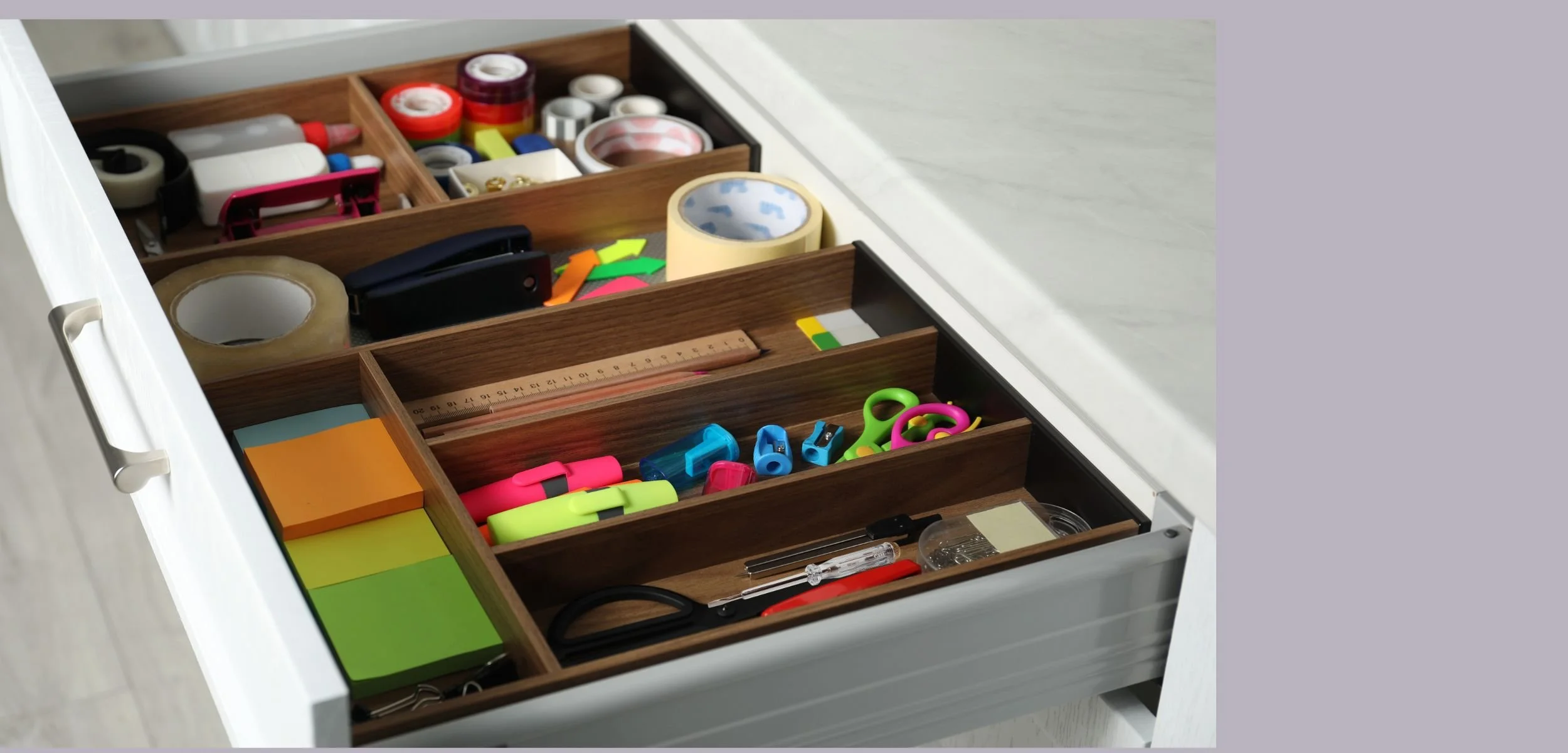
Instead of a chaotic space that agitates you, what if your junk drawer was a space where what you need is simply there — easy to see, easy to grab, no drama attached. You get what you need, you do what you need to do, you put the thing back and you move on with your day.
Doesn’t that sound delightful?!?
Mmmm-hmmm – let’s go!
STEP 1
Breathe
This is where I always begin – a conscious breath. One conscious breath helps you declutter your mind, tune-in to yourself and come into the present moment. This is really the only place from which clear, intentional decisions can be made.
Slowly Inhale 2…3
Slowly Exhale 2…3
Again:
Slowly Inhale 2…3
Slowly Exhale 2…3
STEP 2
Set an Intention
“It is the principle by which I rule my company and it is the principle by which I rule every action in my life - intention.”
An intention is what sets our path forward. It’s like a compass that keeps bringing us back to our values, our true north. Just like a conscious breath brings us back to the present moment, an intention brings us back to our purpose.
This might seem like a big thing to ask for a junk drawer, but it will guide and inform you throughout the process. For example:
My intention is to create a drawer that has me feeling calm when I open it.
My intention is to make this drawer into my handy go-to place for writing implements and paper.
There are infinite possibilities – and there is no right or wrong one.
Where in your home the drawer is located might help determine the intention too. Or what you already have in there might help you figure it out.
The checkbook you reach for every week is so convenient there.
The tiny nail you need to replace before you forget is really too small to put anywhere else.
There really is no other place to put these thumb tacks.
Or, you may decide to switch it up altogether.
Your intention could also start out being one thing and as you move forward, shift into something else.
You're not committing to anything – you’re just giving yourself a starting point.
STEP 3
Empty Your Junk Drawer Completely
Place a towel or a piece of cloth – something that can be washed or tossed afterward on a nearby surface — the counter, the table, even the floor. Now, take everything out of the drawer.
Spread it all out so you can see what you have – even if you don’t know what exactly everything is…
or why someone has kept it. :)
This is also a good time to wipe each item down and do the same with the drawer. Depending on the state of things, you might also want to have a second towel or piece of material to lay the clean items on as you go.
Have a trash bag or can with you so when you come across an item that you immediately recognize as trash, say thank you and discard it.
STEP 4
Group Like With Like
You’re not making any decisions yet. You’re simply sorting into categories so your brain can process things more easily:
Pens with pens. Batteries with batteries. Tools with tools. Lip balm with lip balm. You get the picture. You could also have a pile for “Random”, “What even is this?” or “This doesn’t belong here.”. You can make a category for anything you want.
As you pick up each item to sort it, do so with curiosity NOT judgment. You never know, maybe you’ll find the earring you thought you had lost years ago – how thrilling! Or you may break into hysterical laughter when you recognize that you have been holding onto a paper take-out menu from the diner that closed ten years ago.
I’m here to assure you that it doesn’t matter how your junk drawer got to be the way it is, it only matters that you are starting here. Starting now. Ha, one of my favorite Streisand tunes. Know it?!?
Ok, back to the drawer!
STEP 5
Remove the Actual Junk
This might take a bit of time but it’s worth it – even if you decide some of these things will live someplace else.
Test that all of the batteries and electronic devices work.
Make sure all of the pens and markers write properly.
See if the random keys actually do fit a lock somewhere.
Find out if that unrecognizable charger really does belong to a device.
Is that WhiteOut from 15 years ago all dried out?
Is that broken something really worth fixing?
Can you even crank open that bottle of nail polish? If it's a color you still love, running it under hot water should do the trick!
Let go of anything that no longer works, no longer serves a purpose, or would require more effort to deal with than it's worth.
STEP 6
Revisit Your Intention
Now that you have created clear groups and the actual junk has been removed, you can really see whether your initial intention still holds.
If it does, let it guide you —
Which of these groups actually belong here? What serves the purpose of your intention?
If not, shift your intention and let the new one lead the way.
Some things will be easy – yes, absolutely. Others might need a moment of reflection. And some things might belong somewhere else entirely. Speaking of which, your linen closet is a wonderful place for extras, backups and things you don’t need every day. I have a whole blog post about it! The Hidden Power of Well-Organized Linen Closet
STEP 7
Create Simple Boundaries
The drawer itself is your first boundary. It’s what ultimately determines how much can live there.
Small containers inside the drawer are what will create the boundaries for your categories. Each object and/or category should have a clear home, a logical placement and enough space to be chosen without disturbing anything else.
A candle lid, a small repurposed box, a plastic ice cube tray, one of those little glass dessert containers (Petit Pot — delicious, by the way!) — any of these will do.
And here's where you can tap into your creativity. And before you say you are not creative, I believe everyone is creative. Sometimes it just takes a bit of presence to tap in. :)
Notice the negative space too. If two containers naturally leave just enough room between them for a pair of scissors, for example, you don't need a container for the scissors. The space itself becomes the boundary. Love when that happens!
The containers don't have to match — but they can, if that's joy-producing. What matters is that things don't swish around every time you open and close the drawer.
Now, if a container comfortably holds eight of what you want to put there and you have twelve of that item, ask yourself:
How many of these do I actually use?
Which are the best versions?
What am I holding onto just out of habit?
And if something still has value but no longer belongs in your home, someone out there will be genuinely glad to come upon your donation.
Editing isn't about deprivation. It's about respect for your space – and for yourself.
As you place your things back in the drawer, you'll naturally start to see what works and what doesn't. Try a container, see how it fits, adjust as needed. Think of it more as experimentation rather than an exact science. This part can actually be quite fun!
Ready to bring that same satisfying feeling to the rest of your home?
Here is the link to my free guide - Organize with Intention
to help you tackle every space with the same intention, one drawer at a time.
You Don’t Have to Have a Junk Drawer
Maybe you already have a place for everything elsewhere in your home. Maybe the idea of one more drawer to manage feels unnecessary. That’s completely fine. The goal here isn’t to force a specific system. It’s to create something that works with the way you live.
What I have instead of a traditional junk drawer is a bits-and-pieces box in my kitchen.
At the moment its contents are:
A pair of earrings I need to fix
A screw from a bar cart I want to match at the hardware store
Blank Post-Its
Scrap paper
One pen
One pencil
Some Spanish vocabulary words – the ones that for some reason don’t stick
A few Yiddish words I like to remember, written on a small piece of paper
A soft measuring tape so I can quickly grab it for all kinds of projects
A cute and colorful snail magnet I just like to look at
The box doesn’t have a lid — on purpose.
My intention for this box is to have a place for the things I want to remind myself of every day — so nothing gets lost or forgotten.
Junk is Junk
Who needs it? We don’t. Not in our minds, not in our lives, not in our drawers.
Your junk drawer deserves better and so do you!
When junk is out of our lives, so many things happen.
We are lighter.
We have less stress.
Our intentions are more easily fulfilled.
Our minds are clearer.
We can be here. Now. Present.
It’s one of the things I love most about decluttering and organizing – it creates space – everywhere.
STEP 8
Close the Drawer and Breathe Again
Before you walk away, pause.
Take another conscious breath.
Slowly Inhale 2…3
Slowly Exhale 2…3
Again:
Slowly Inhale 2…3
Slowly Exhale 2…3
That drawer that used to agitate you, distract you, pull you out of yourself? It's now a small, steady, intentional ally in your day.
You get what you need, you do what you need to do, you put the thing back and you move on with your day. How awesome is that?!?
If you'd like one-on-one guidance in creating systems like this in your home, I'd love to connect with you for a
complimentary consultation.
~ Selena